From sensitive portraits by Peter Hujar to Old Master paintings depicting beauty and ugliness, there’s so much to see within a day’s trip from the Maastricht fair
By Samuel Reilly, published March 1, 2026. From the March 2026 issue of Apollo.
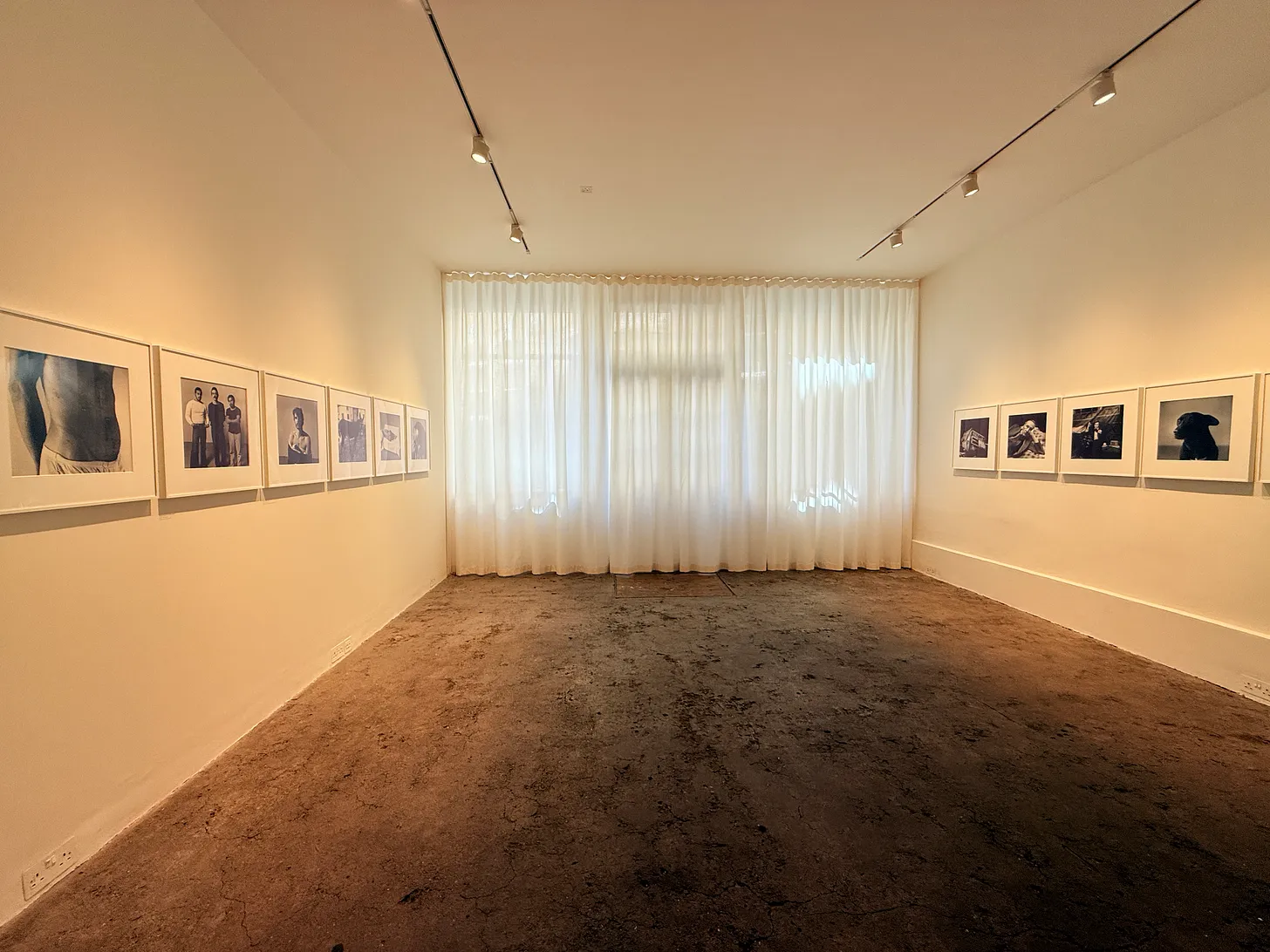
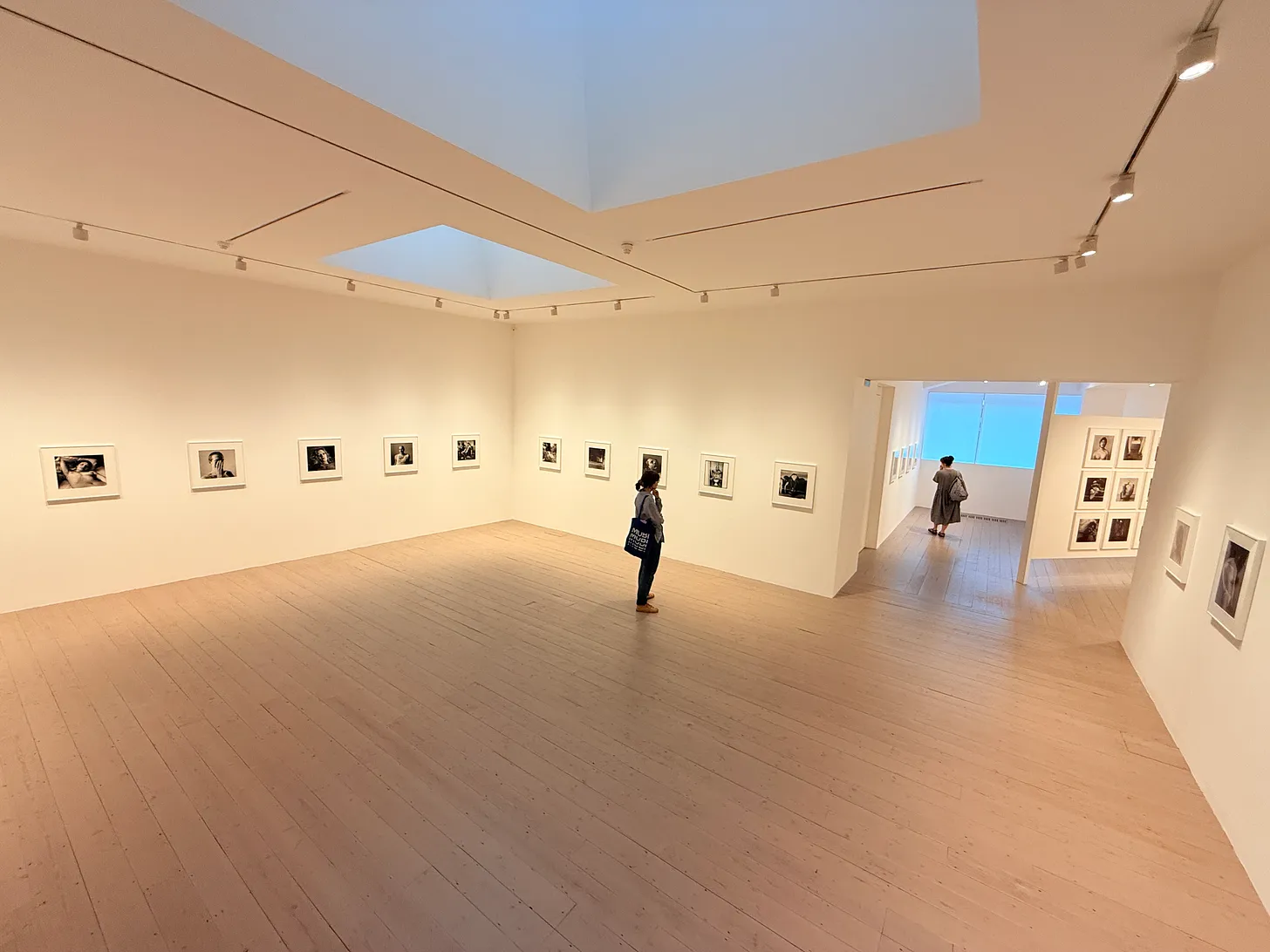
Peter Hujar is best known for his photographic portraits: essential records of the downtown New York scene of the 1970s and ’80s in which he was a key participant until his death from Aids-related pneumonia in 1987. Curated by Hujar’s biographer John Douglas Millar and his friend and printer Gary Schneider, this exhibition was widely acclaimed during its first run at Raven Row in London last year for revealing the true breadth of Hujar’s vision. Portraits of friends and collaborators including Susan Sontag, David Wojnarowicz, Paul Thek and William S. Burroughs, ranging from the tender to the provocative, are on display alongside less well-known compositions, including Hujar’s studies of the glittering waters of the Hudson.
“Eyes Open in the Dark” in Bonn: Peter Hujar’s portraits show the life of the queer New York scene of the 1970s and 1980s.
It is a true symphony of powerful gazes and intimate glimpses, of observations that are never casual, but rather capture moments from the life of the US photographer Peter Hujar in stark, stark black and white. With his portraits of friends and lovers, the people who flanked his everyday life in the clubs, on the stages, and on the streets of downtown Manhattan, Hujar retrospectively became a chronicler of the 1970s and 1980s. He himself did not aspire to this. The refined and, at heart, apolitical aesthete could not, however, as a photographer and part of the scene, avoid registering the socio-political urgency of the emerging gay rights movement and with, great empathy, capturing the incredible tragedy that AIDS brought with it in melancholic images.
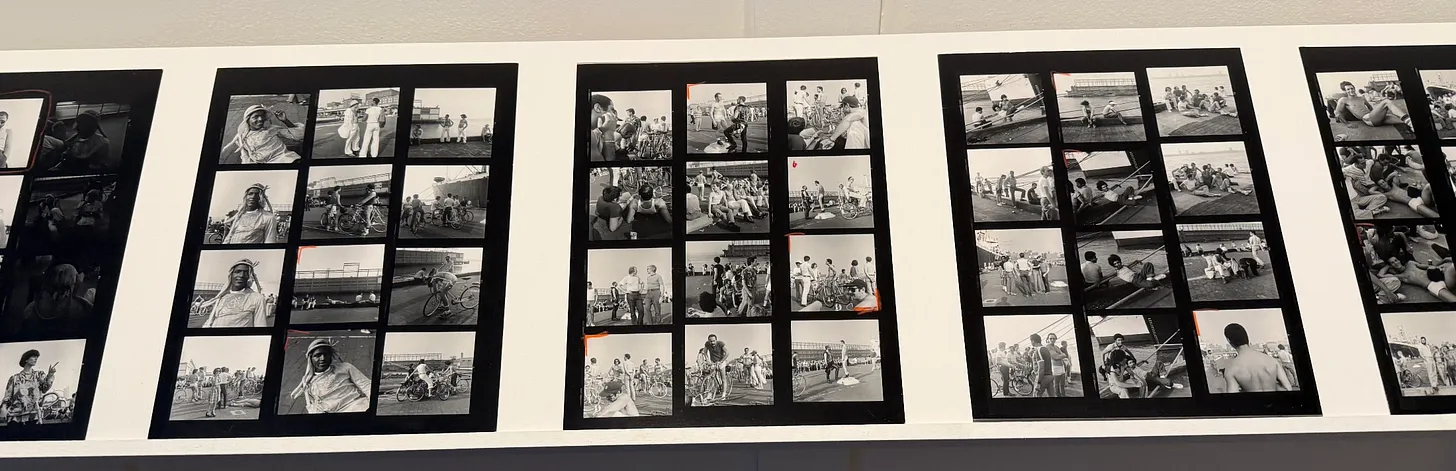
In the exhibition “Eyes Open in the Dark” at the Bundeskunsthalle, Hujar accompanies the lively street parties of the queer community at the West Side Piers with his camera on Easter Sunday 1976 and photographs his ex-lover, the dancer Bruce de Sainte Croix, naked. First as the epitome of youthful innocence and vulnerability like Michelangelo’s “David”, then sitting and preoccupied with his erection, finally kneeling in masturbation: a triptych with which Hujar and Sainte Croix move into a “forbidden zone” of male nude photography, as Sainte Croix admits in an interview (the exhibition is recommended for ages 18 and up).
A few years later, the mood shifted abruptly: with the first AIDS diagnoses and the first deaths in the scene, Hujar’s visual world darkened. In January 1987, he was diagnosed with the autoimmune disease. At the end of the year, he died of AIDS-related pneumonia. “23 photos of Peter. 23 genes in one chromosome. Room 1423” reads an envelope containing contact prints made by his former lover, David Wojnarowicz, of his deceased friend. Three very powerful studies from the series are on display in the Bonn exhibition. Wojnarowicz died of AIDS in 1992; the painter Paul Thek, one of the most influential people in the photographer’s life succumbed to the disease six months after Hujar. In Room 1423, Hujar had photographed the dying Candy Darling—a star from Andy Warhol’s Factory—in 1974.
The exhibition begins with juxtaposition of all of Hujar’s thematic areas: a woman’s shoe (for Elizabeth) and a dead cat, the portrait of actor and editor of the magazine “Gay Power,” John Heys, a urinating stranger, a discarded carpet, a New York backyard and parking spaces, drag star John Flowers on the toilet, or Richie Gallo in an S&M costume on the sidelines of the production “The Life & Times of Joseph Stalin.” Hujar himself is said to have appreciated this type of presentation. He called it “Grid.” He practiced the principle in the underground newspaper “Newspaper” as well as in his last exhibition. Hujar wanted to create the associative leaps that exciting juxtapositions enable.
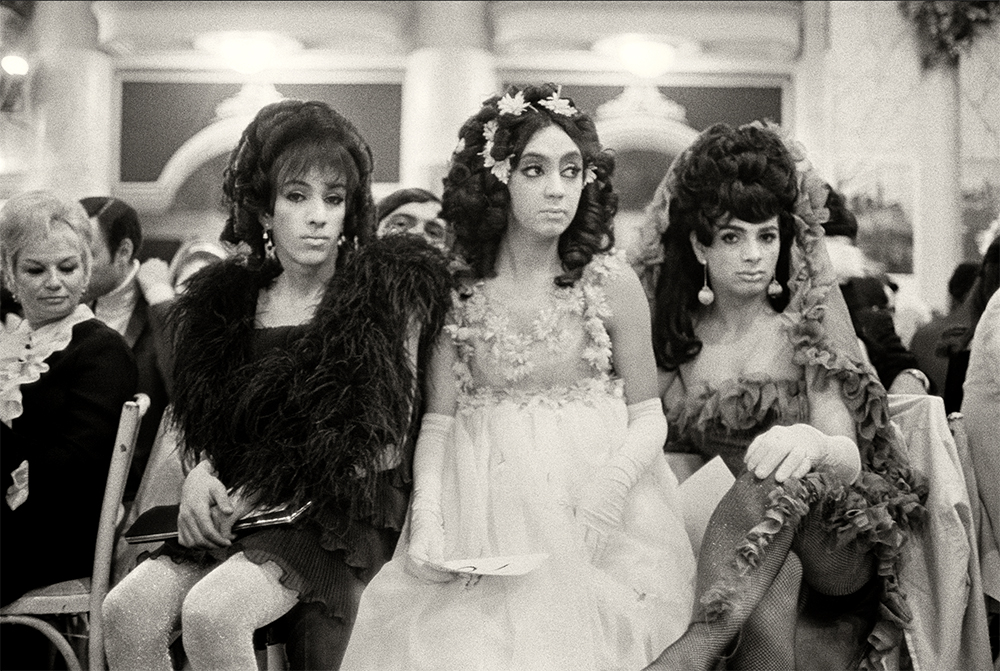
“Eyes Open in the Dark” is a captivating, fast-paced, breathtaking, and atmospheric kaleidoscope of the New York scene, further charged by the intensity of the gazes. There are Butch and Buster, fixing the viewer with their eyes, Cookie Meuller gazing into the distance with bedroom eyes, and baby John McClellan blinking in the camera. The writer William Burroughs, in a boldly patterned outfit, gazes up sadly from his plaid blanket, and the publicist Susan Sontag broods over something with her arms folded behind her head.
Butch and Buster, by the way, are two cows that Hujar photographed in Westtown New York. Throughout his life, Hujar also felt connected to that sphere. After all, the photographer, born in 1934 in Trenton, New Jersey, had grown up on the farm of his Galician-Ukrainian grandparents before his mother, Rose, moved to Manhattan with Peter in 1945. Hujar’s youth was marked by alcoholism, verbal and physical violence. He studied photography, received important inspiration on a trip to Italy, and through contact with neorealist directors such as Federico Fellini and Michelangelo Antonioni, through Paul Thek, the writers Linda Rosenkrantz and Susan Sontag, he came into contact with intellectual circles. For a long lime. Hujar was considered an insider tip in Germany — after all, Klaus Honnef showed photographs by Hujar in his 1982 exhibition “Lichtbildnisse” (Portraits) at the Rheinisches Landesmuscum Bonn. However, his work is currently experiencing a true renaissance. In addition to “Eyes Open in the Dark” in Bonn, in cooperation with Raven Row, London, and the Hujar Foundation, the Gropius Bau in Berlin is also celebrating the photographer simultaneously, together with the New York painter Liz Deschenes. Last autumn, Ira Sachs brought his sensitive portrait “Peter Hujar’s Day” to cinemas. Ben Whishaw plays the photographer. The film is based on a 1974 tape interview. In it, he recounts how he photographed Allen Ginsberg on the Lower East Side. The Beat Generation star was sitting in the lotus position in a doorway and began to sing. Hujar was disturbed: “May God interrupt me?”
(This article has been translated from the original German.)
“Eyes Open in the Dark” will be exhibited at Bundeskunsthalle in Bonn, Germany from February 27–August 23, 2026. See exhibition details.
Given Peter Hujar’s talent for capturing subjects in quiet, vulnerable moments, exhibitions of his black-and-white portrait photography tend to feel like intimate affairs, but this survey in Bonn feels especially personal. It was co-curated by his friend Gary Schneider and his biographer John Douglas Millar (27 February–23 August). The exhibition, which first ran at Raven Row in London last year, assembles snapshots the artist took in New York between the mid 1970s and mid ’80s. These range from the deeply personal, such as a photo of Hujar’s friend and lover Paul Thek lying in a clearing among Florida pines, to the artfully staged – including Hujar’s shot of the Warhol superstar Candy Darling on her deathbed, staring down the camera, in 1973. Also on display are photos of William S. Burroughs and Susan Sontag, striking cityscapes and a haunting photo of a cow behind barbed wire – taken in a farm in Westtown near the New Jersey border – that Hujar once referred to as a self-portrait.
Find out more from the Bundeskunsthalle’s website.
The actor reunites with director Ira Sachs on a new, experimental biopic about the iconic photographer. Here, they discuss why his work still resonates today
Published January 5, 2026 in Dazed. Text by Nick Chen
Peter Hujar’s Day (Film Still) Courtesy Janus Films
Ben Whishaw is a notoriously private person. Nevertheless, I’ve started our interview by asking the 45-year-old British actor how he got out of bed the previous day. “Yesterday, I woke up at around 7:30, but I knew I wanted more sleep,” says Whishaw. “I had a sense of excitement, because I’d had a really busy few days leading up to that morning, and I was like, ‘Ah, I don’t have to be anywhere.’ I turned over and lay in the dark for another half an hour. I got up and made myself a coffee. I didn’t have any breakfast. Maybe a handful of nuts.”
It’s a Thursday afternoon, on December 4, 2025, when I meet Whishaw and the 60-year-old American director Ira Sachs at the Londoner Hotel. Their latest collaboration after 2023’s Passages is Peter Hujar’s Day, a genre-defying film that’s neither documentary nor fiction. On December 19, 1974, the celebrated queer photographer Peter Hujar described his previous day in great detail to Linda Rosenkrantz, a writer who recorded and transcribed their conversation. With Whishaw and Rebecca Hall as the leads, Sachs’ film recreates that day’s events – not the day described, but the describing itself.
The result is hypnotic and deceptively simple: for 70 minutes, it’s a dialogue that focuses on the photographer’s previous day and nothing else. The action, if you can call it that, never leaves Rosenkrantz’s New York flat, except for smoke breaks on the balcony. It’s full of tantalising contradictions: a wordy, stagey piece that’s cinematic through grainy cinematography and avant-garde cutaways; an immersive, grounded drama that’s so Brechtian it ends on an applause break.
“It’s important to state emphatically that I had no mission to introduce people to Peter Hujar,” says Sachs. “It’s really about two actors on a set who are transmitting this conversation between Peter and Linda.” But it’s a happy accident if viewers discover Hujar’s work? “I like that you’re pushing back, even though I say that wasn’t my intention. On no level would I not want people to discover his work, because his work is a gift, particularly to queer people.”
In 1974, Hujar is 40 years old and ascending in his career. His previous day involves talking to Susan Sontag on the phone, and photographing Allen Ginsberg for the New York Times; he name-drops acquaintances like Fran Lebowitz, William S. Burroughs and Ed Baynard. He frets his day is “boring”, yet his account, including the ordering of Chinese food, is engrossing. It’s ultimately Hujar’s inquisitive energy, not his photography, that’s on display.
Sachs and Whishaw are avowed fans, the latter owning a 1980 self-portrait called “Seated Self-Portrait Depressed” in his home. “His art will always be as if it was made today,” says Whishaw. “It feels alive. He managed to catch an intimacy with people – actually, not just people, but frequently animals as well – where he could get them to be so open to him. When I try to take photos, that exchange is difficult, because lots of people understandably don’t want to be photographed. It’s quite an aggressive act, photographing someone. You’re sort of taking something from them. To encourage someone to feel relaxed, open, and able to be intimate – that was his great genius. And it’s what he saw in people as well.”
Sachs discovered the transcript in a gay book shop in France during the shooting of Passages. By then, the ums and ahs had already been removed. “The transcript is quite musical, exact and verbatim,” says Sachs. “I’m certain when Linda typed it up 51 years ago, she removed several ums. But she did not remove the natural inflexion of how people talk in conversation.”
“I had an impulse to make it more, ‘Oh, let me just find this word or phrase,’” says Whishaw. “But Ira kept saying, ‘Just keep talking.’ It had to have a certain amount of tension in it. It couldn’t just become soggy, meandering language.”
Hujar died in 1987, aged 53, from Aids. Throughout the film, Hujar agonises about his health and mortality; Rosenkrantz pleads for him to eat more vegetables. When Hujar describes closing his eyes and going to sleep, there’s a poetic finality to the statement.
“It’s a kind of literary device,” says Sachs. “We know more than the character, and that his life will end in 13 years.” But he’s agreed to be documented, and is preserving his legacy? “Yeah, but he’s really un-self-conscious, which I admire. His lack of defensiveness and trust in Linda is quite deep. It’s something I could never experience with my own therapist – he seems to totally trust that she’s going to be interested in anything he says.”
Peter Hujar’s Day (Film Still) Courtesy Janus Films
The first room at Raven Row with bodies, friends, animals, and people like William Burroughs.
‘ Without resorting to hyperbole, [Eyes Open in the Dark] was one of the best exhibitions I’ve ever seen. Hujar’s photographs have a sublime stillness, they evoke a devastating sense of presence. The quality and consistency of the prints allow the viewer to flow from one image to the next, without being interrupted by questions of form. His photographs show life made visible by the presence of death: sex and death, friendship and death, love and death, awareness and death. As his friend Susan Sontag wrote in her diary in 1976: “Death is the opposite of everything.” …
…Inspired by this ecstatic encounter, I got in touch with the co-curator, John Douglas Millar, who kindly agreed to speak to me about Hujar and the exhibition. ‘
Contact sheets from Peter Hujar’s journey on Easter Sunday 1976
“NS-You’ve co-curated this exhibition and are currently writing a biography of Hujar, I am curious about the extent to which the exhibition is a way of shining a light on his life in a particular way.
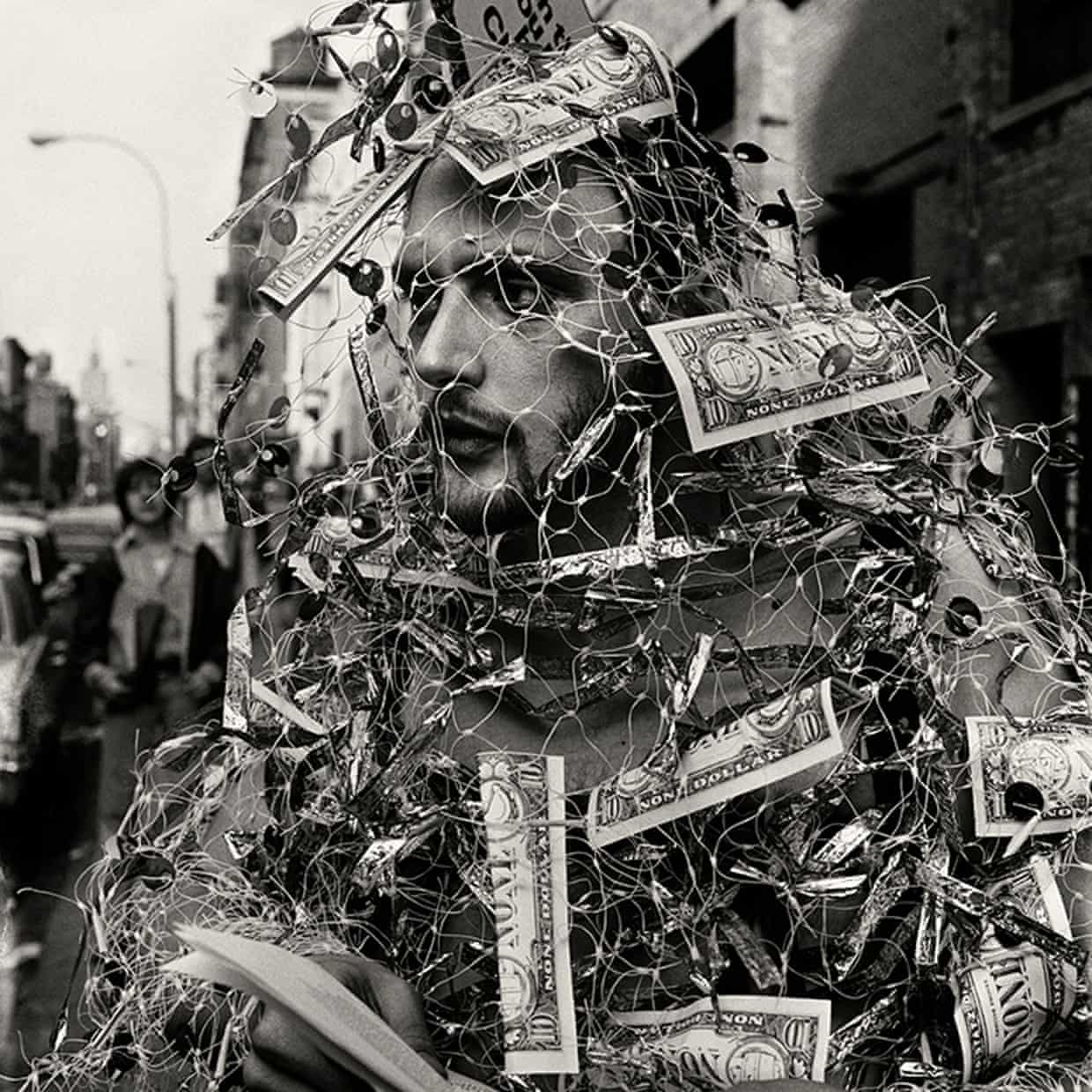
JDM- Absolutely. The top floor of the exhibition is all about 1976. The room that contains the contact sheets and the images from Easter Sunday, those two rooms and the David Wojnarowicz Sex Series piece. That is basically the first chapter of the book. You can follow Hujar around Manhattan on Easter Sunday 1976. He begins uptown shooting the faithful on the steps of Saint Patrick’s on 50th and 5th. Then moves down to the West Side piers where he shoots this very ebullient queer scene, and then at the end of the day he ascends the World Trade Center and takes a photo that scans across the East River, catches the edge of the Lower East Side and the cruising grounds around the decommissioned naval docks in Brooklyn. It’s a remarkable day. And in those contact sheets you can see Marsha P Johnston, Stephen Varble, Camille O’Grady and others. It’s very rich, inherently novelistic really. Downstairs is much more of an associative hang that was done in situ. Gary Schneider [the other co-curator] and I worked for two years on which images were going to go into the show, so we really had a feel for these particular images before installing them.”
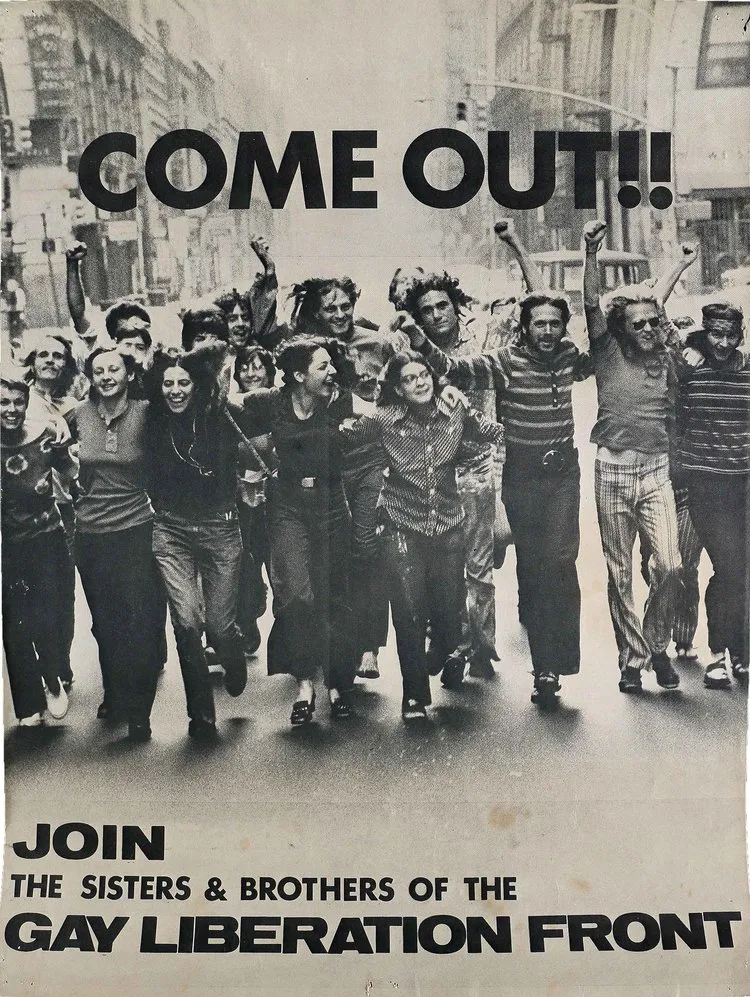
“NS-There is a timeless quality to this work. The only image in the exhibition that feels trapped in time is the political poster. JDM-Yes, and that was done as a favour. I don’t think he would’ve counted that as part of his oeuvre necessarily. NS-It feels like queer culture is increasingly being absorbed into the mainstream. You’ve got the Leigh Bowery show opening this weekend, Drag Race, Derek Jarman in Glasgow, and most contemporary art exhibitions I see … I’m curious how normies utilise this stuff. For instance, as someone who is interested in Walter Benjamin, do you think cruising is an extension of the flâneur’s way of exploring the world? JDM-When I originally started thinking about a book on Hujar, I thought he would almost stand in as a Baudelaire figure, as Baudelaire had been for Walter Benjamin. When I was saying I wanted to do a materialist history of that period in New York—or sometimes I think of it as a Balzacian approach—that has to do with being worried about versions of historicization of that period. It’s a positive that certain histories are being discovered and presented and so on, but I think there are risks in how that happens. There were questions about the David Wojnarowicz exhibition at the Whitney in 2018. ACT UP were protesting outside because they felt that it was historicizing work in which there was still an ongoing struggle, saying isn’t it great that America got over AIDS. I would hate to think that the exhibition at Raven Row did that. At the same time, how do you—to use Benjamin’s term—make the work detonate in the present? It’s a complex question.”
” By rights, Peter Hujar should be far more famous than he is.
Born in New Jersey in 1934, the photographer was a contemporary of Robert Mapplethorpe and Nan Goldin, and a close friend and sometime lover of Paul Thek and David Wojnarowicz. He rubbed shoulders with countless artists and literary luminaries, photographing everyone from Andy Warhol, Susan Sontag and Wiliam S. Burroughs to Greer Langton, John Waters and Cookie Mueller. Pretty much anyone notable in the thriving art scene of downtown Manhattan in the 1970s and ’80s was acquainted with Hujar. “
“This exhibition is a timely one, coinciding with the imminent portrayal of the artist on the big screen in Peter Hujar’s Day, an Ira Sachs-directed two-hander based on a book by Hujar’s friend Linda Rosenkrantz. Starring Ben Whishaw and Rebecca Hall, the film got great reviews when it premiered at Sundance in January, and will receive a wider release later this year. The exhibition’s co-curator, art critic John Douglas Millar, is also hard at work on a forthcoming biography that will be published through the prestigious imprint Fitzcarraldo Editions.
A mere four decades after his death, it seems that Hujar is finally getting his dues as a major force in 20th-century photography.” – Rosie Hewitson
Peter Hujar’s Eyes Open in the Dark is filled with intimacies and confrontations, empty lots, New York up close and seen from afar, hidden spaces and days in the country, sex and bodies, life and death. The effects are cumulative, taking us on a journey that is filled with variety, tenderness and vulnerability, surprise and shock.
This unique exhibition catalogue, published with Rodovid Press in Kyiv in conjunction with the artist’s exhibition at The Ukrainian Museum, provides new insights into the seminal and lesser- known aspects of Peter Hujar’s career, living and working in the Ukrainian Village. The exhibition explores the first fifteen years of Hujar’s professional career. He was a consummate technician, and his portraits of people, animals and landscapes, with their exquisite black-and-white tonalities, were extremely influential. Highly emotional yet stripped of excess, Hujar’s photographs are always beautiful, although rarely in a conventional way.
The lushly illustrated publication features 77 photographs, some never seen or published. Three important interviews with Hujar’s closest friends and colleagues, plus a scholarly essay on his work with the photographer Richard Avedon, chronicle Hujar’s ceaseless creative exploration and observation of life in the East Village of New York.
A new edition of the cult classic photography book by the legendary Peter Hujar.
“I am moved by the purity of [Hujar’s] intentions…. These memento mori can exorcise morbidity as effectively as they evoke its sweet poetry and its panic.” —Susan Sontag
Portraits in Life and Death is the only book of photographs published by Peter Hujar during his lifetime. The twenty-nine portraits of creative people—ranging from William Burroughs, Susan Sontag, and John Waters to Larry Ree, founder of the Trocadero Gloxinia Ballet Company, and T.C. (whose identity is unclear)—possess a haunting beauty and degree of psychological examination that is both offbeat and riveting. Following the portraits come eleven images that can only be described as devastating: pictures of semi-preserved, clothed bodies of nineteenth-century Sicilians found in the arid catacombs beneath a church in Palermo.
There is no necessary connection in the photographs themselves or between the two sections of the book, yet the pictorial progression from life to death is an emblem of the journey we all take. The living subjects seem to be meditating on the mortality that is limned with such profound effect in the catacomb pictures. In different ways, both groups of images speak to the basic fears and emotions that we carry with us, somewhere beyond our consciousness. After viewing this extraordinary book, it is almost impossible not to make those connections and interpretations or be moved by Hujar’s consistent ability to convey what appears to be the inner spirit of his subjects.
Even so, an air of nonchalance, even gaiety, hovers over the photographs. The book is odd, oblique, sometimes opaque, and certainly deeply felt; but it sticks to the mind like a burr. It will be noticed. Once seen, it cannot be forgotten.
Peter Hujar Behind the Camera and in the Darkroom,
Intimate remembrances of Peter Hujar from his friend, posthumous printer and sometimes subject Gary Schneider
This suite of heartfelt accounts invites the reader firsthand into artist Gary Schneider’s journeys in image making with his friend and mentor, the beloved photographer Peter Hujar (1934–87). Drawing from a selection of Hujar’s pictures, Schneider (born 1954) takes each image as a point of departure to share his expertise as Hujar’s posthumous printer. Outside the darkroom, Schneider situates his chronicle squarely within the transformative social shifts of downtown New York City in the nascent years of the AIDS crisis. Through a mix of Schneider’s stories and technical prowess, he creates a rich tapestry that serves both as a historical testimony and a portrait of their relationship.
Schneider also writes in captivating detail describing his experience with Peter Hujar refining his abilities as a printer, as a subject of Hujar’s portraiture, as an extra hand accompanying the photographer on cruisy, nighttime shoots, and of when he turned the lens on Hujar to record him as a subject in his filmic work. Informative as it is stirring, Peter Hujar Behind the Camera and in the Darkroom is an indelible portrait of a relationship delineated by photography, desire and gratitude.
Peter Hujar Behind the Camera and in the Darkroom is published by Bookcrave Books